“It can’t be 10 o’clock! Can it?”
My wife doesn’t do mornings.
She has pajamas with those very words printed across the bum: I don’t do mornings.
She has never done mornings. Ask her sisters and they’ll tell you. Her two youngest sisters, then in their pre-teens, used to visit her in London. In the morning, they’d wake up and clean the disheveled flat of their art-university sister while she “woke up” in bed with a cup of tea and a look of “don’t talk to me or I’ll bite.” The two girls were fed leftover onion bhajjis for their labors.
She still doesn’t do mornings some 15 years later.
For me, I have options on how to react. [continue reading…]

Smile and live. That’s a good motto.
My son and I laid back on my bed the other day.
It was late in the afternoon and the girls were getting ready to go out and we know what that meant: a good half an hour of waiting.
So we stared at the ceiling and watched the ceiling fan spin round.
“Hey, look at that,” I said, pointing up at a wood beam.
“What?” the seven-year-old asked.
“A spider, there.”
“Oh, yeah,” he said.
We watched the spider crawl along the beam, and I said, “What if it fell and landed on…” – I raised my arm and let it fall on my son’s chest – … on you?”
He giggled and then did the same motion with his arm and said, “On you!”
We both laughed. [continue reading…]

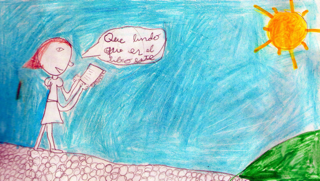
“What a beautiful book.”
My wife and I have been living in Argentina for years, her for 17 and me for 18. Over this time, we have picked up Spanish to the extent that we have incorporated a raft of Spanish words – and amalgamations – into our native English.
Take venced, for example.
I will open the fridge and say, “Uh oh, the milk has venced.”
Venced, of course, is our made-up word based on vencimiento, or Spanish for expiration, as in the expiry date or when you know that the milk is out of date. So you look at the packaging for the expiration date and you read “vto” or “venc” or something of the like and then the date. This triggers in your head the word vencimiento, which you cut short to “venc” and then add the “ed” and, presto, you’ve got “venced.” [continue reading…]